Doorway, Arcade or Recess: Reading a Building Entrance
Read a building entrance by comparing a doorway, an arcade, and a recess, and learn how each shapes the approach, visibility, shelter, and path to the door.
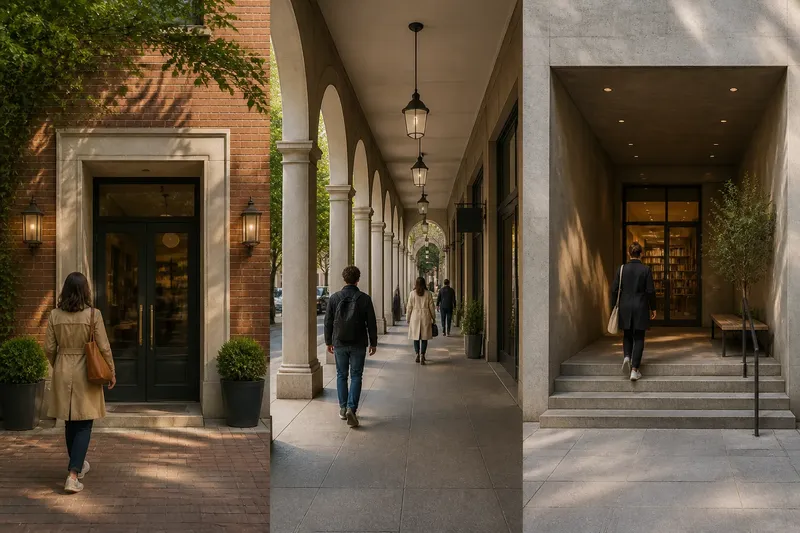
A building entrance changes how you approach the wall before you reach the door. To read a building entrance, compare a focused doorway, a continuing arcade, and a recessed pocket; each shapes the path, the view, and the place to pause in a different way.
Start from the public route rather than standing squarely in front of the door. Notice when the entrance comes into view, whether the approach is covered, and how the threshold connects to the sidewalk. Describe what a person can see and do without guessing why the building was designed that way.
A doorway gathers movement at one opening
A doorway is a distinct opening in a wall or façade, usually marked by a door, frame, sign, or change in material. It gives the approach a clear target. From the sidewalk, you might find it between windows, beneath a sign, or beyond a short forecourt.
Follow the last part of the route. Is there a straight path to the door, or does a planter make visitors angle around it? Can someone tell where to stop and whether the door swings inward or outward? A canopy or a change in paving may reinforce the approach, but neither is needed for the entrance to read as a doorway.
Glass can reveal a lobby or someone approaching from inside; an opaque door keeps the interior out of view until it opens. A shallow frame may look like a recess from one angle, so check whether the façade creates a pocket of space or simply outlines the opening.
Then look back toward the sidewalk. Does the door remain easy to identify, or does it blend into windows and signs? That simple change of viewpoint tells you how clearly the entrance announces itself.
An arcade carries people along the building edge
An arcade is a covered walkway beside or through a building edge, often supported by columns, piers, or a continuous wall. It offers a route along the façade rather than directing everyone to one door. Entrances may open from it at intervals, so the passage can connect several destinations.
As you enter, the view changes in stages. The covered line may lead you forward, while gaps between supports frame the street, a courtyard, or shopfronts. Someone can continue along the passage without entering the building, while a visitor heading for a door can step aside from the through-route.
Look for where the cover begins and ends, and whether the route turns a corner. The pattern of doors can suggest whether the arcade serves one destination or several. A canopy over a single door shelters a threshold, but it does not make a continuing passage.
Do not assume every colonnade is open for public movement. Signs, gates, and connections to nearby streets help show what a passerby can use. Follow posted notices and local rules.
A recess makes a pocket before the threshold
A recessed entrance sits behind the building’s main face. The façade may form a deep niche around one door, or a larger cutout may include steps, seating, or a vestibule. Unlike an arcade, a recess usually gathers people at one entrance rather than carrying them along the frontage.
From an oblique angle, the outer wall may hide the door. Move closer or change direction, and the opening comes into view. Once inside the pocket, the walls frame the view back toward the street. Notice whether the space is covered or open to the sky, and whether the route is level, stepped, or reached by a ramp.
Imagine an invented situation: a visitor approaches a library with a door set deep inside a broad façade niche. The visitor sees the sign from the sidewalk but not the door, walks toward the niche, and then spots the entrance under the overhang. The observable sequence is approach, reveal, pause, and entry; the pocket also leaves the passing sidewalk clear while the visitor waits.
Compare the forms along one continuous route
Follow the same route from the public way to the threshold. Note the point where the entrance first appears, what the path does next, and whether there is room to pause without blocking others. This keeps architectural labels tied to an observable experience.
- Doorway: If you see a distinct opening and a direct approach, describe it as a focused threshold; if obstacles or signs obscure the route, note those and trace how a visitor reaches the door.
- Arcade: If a covered passage continues along the façade and connects to doors, describe it as a shared route; if the cover shelters only one threshold, describe it as a canopy instead.
- Recess: If the façade creates a pocket behind its main face, describe the entrance as recessed; if the door is only set within a shallow frame, describe it as a doorway.
- Visibility: If the door appears from the sidewalk, record that sightline; if it appears only after a turn or closer approach, record where the view changes.
- Shelter: If the approach has a roof or overhang, note where it begins and ends; if the route is exposed, note that instead of assuming there is a sheltered waiting place.
- Threshold route: If the path is level, describe the continuous approach; if it includes a step or ramp, record the visible change and avoid making a broad access judgment from appearance alone.
Some entrances combine forms. A door may sit in a recess at the end of an arcade. Describe the dominant spatial effect first—“an arcade leads to a recessed door,” for example—then add the feature that completes the approach.
Keep the wording specific. “The entrance is hidden” gives little information; “the outer wall screens the door until the final turn” tells a reader what changes along the route. “The arcade is welcoming” is less precise than “the covered passage lets people reach several doors while staying out of the rain.”
Read how the entrance shapes movement and sight
A doorway concentrates movement at one marked opening. An arcade carries people along a sheltered edge and distributes them among doors. A recess draws people off the main line of travel into a pocket before they cross the threshold. These are patterns to observe, not rules about how every visitor behaves.
Visibility follows the same practical logic. A doorway may make its target clear early while concealing the interior. An arcade can keep the route visible and reveal doors in sequence. A recess may delay the view of the door, then frame the view back to the street. Glazing, lighting, signs, and nearby obstacles can change any of these effects.
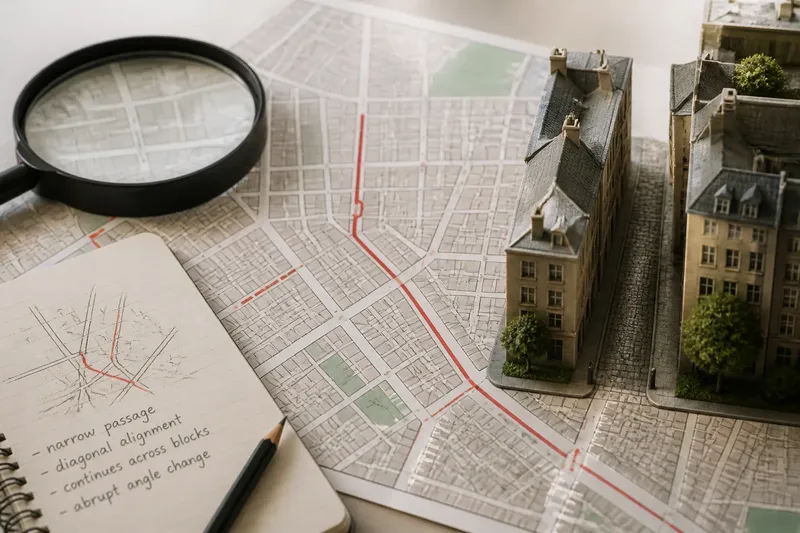
For a useful field note, record the approach direction, where the door first becomes visible, and whether the space before it is open, covered, or enclosed by the façade. A quick sketch with arrows often captures the path and sightline more clearly than a straight-on photo. If you take pictures, stay clear of the entrance and consider the privacy of people nearby.
What do readers often ask about building entrances?
How can you tell a doorway from a recess?
A doorway is an opening in the façade; a recess adds a pocket set behind the main face. Look for space to step into before reaching the door, not just a frame around it.
What makes an arcade different from a covered entrance?
An arcade is a passage that continues along or through a building edge, often connecting more than one point of access. A canopy over one door shelters that threshold but does not create a continuing route.
Why might a recessed door be hard to see?
The façade’s outer edge can screen the door from a side approach, so it may appear only as you move closer or change angle. Signs, lighting, glazing, and nearby obstacles can make it easier or harder to identify.
Which entrance form is easiest to approach?
There is no single answer without considering the route, the person arriving, and the entrance’s details. Describe the path, cover, visibility, and threshold conditions; consult a qualified professional if you need a specific access or safety judgment.
A useful reading of a building entrance follows the route until the public way becomes the building’s interior. On your next walk, note whether a doorway draws you straight in, an arcade carries you along the frontage, or a recess gives you a pocket before entry. The main search phrase, building entrance, becomes easier to apply when you describe that sequence rather than the façade alone.