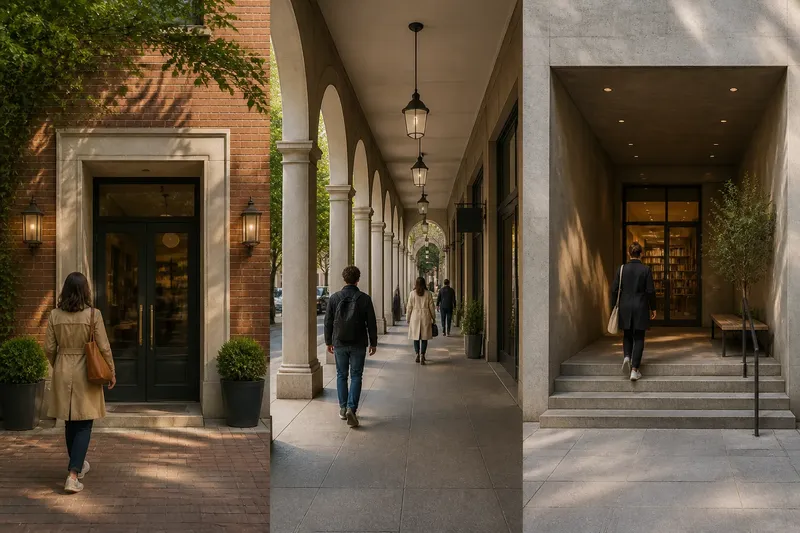
The Street Edge: Where Building Meets Pavement
Read the street edge through setbacks, doors, and ground-floor openings to see how a building’s meeting with the pavement shapes enclosure.
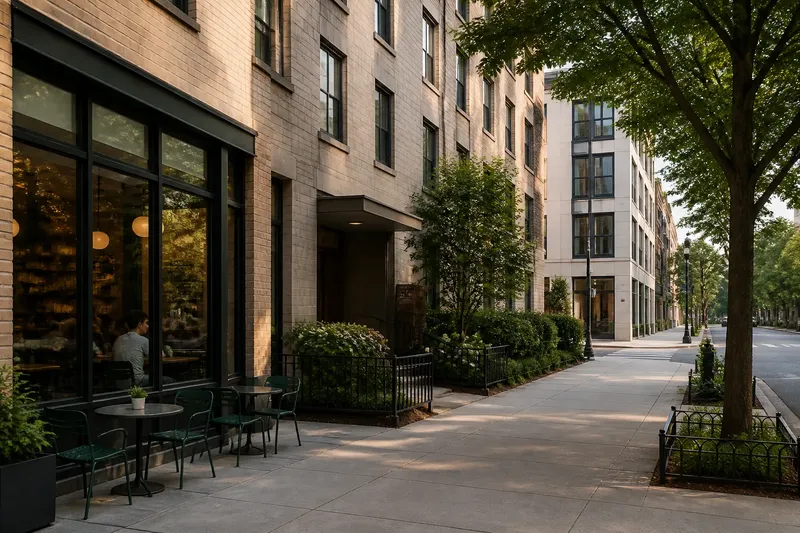
The street edge can make a broad pavement feel sheltered or leave a narrow one exposed, even when the building height barely changes. To read the street edge, watch how the building meets the public footway: where its wall sits, how often doors and windows interrupt it, and what happens along the route between one frontage and the next.
Here is a clearly invented walk through an ordinary block. Its details are hypothetical, but the method is useful on a real street: choose a short stretch, observe the boundary at walking pace, and connect visible features to the sense of enclosure they create.
Start with the block and a clear question
Imagine arriving at a neighborhood block where the pavement widens near a café, narrows beside an older apartment building, then opens again at a small side street. You want to understand why one portion feels defined and another feels loose—not to rate the street, but to describe how its edges work.
Begin at a corner and pick a single side of the block. Walk its public pavement from one intersection to the next, then return if the light or passing activity made details hard to see. Keep attention on the building-to-pavement boundary rather than drifting into a general inventory of traffic, trees, or storefronts.
A useful first question is: does the frontage hold a fairly steady line, or does it step in and out? That line gives the walk a basic frame. Other features—doors, windows, columns, blank walls—tell you how consistently the building participates in that frame.
Read the building line before judging enclosure
In the invented block, the café sits near the pavement, while the apartment building has a recessed entry bay and a short setback where shrubs grow. At the side street, the next building returns to the pavement edge. The route therefore has a mostly clear boundary, punctuated by a few visible retreats.
Look for the difference between a deep, continuous setback and a small recess. A broad forecourt can separate the facade from people walking along the footway, so the building may contribute less to the immediate street boundary. A shallow step back may barely loosen the edge, especially if neighboring frontages continue close to the pavement.
Notice the surface between the wall and the public route, too. A planted strip, a forecourt, a ramp, or a row of columns can mark a transition without removing the building from view. These features do not all create the same effect: a low planting bed can keep a frontage legible, while a wide empty apron may leave a larger gap in the street’s enclosure.
Describe what you can see before deciding what it means. “The wall moves back behind a planted strip” is more useful than “the frontage feels unfriendly.” The first observation can support several interpretations; the second turns a passing impression into a verdict.
Count openings as interruptions in the edge
Now imagine the walker notices that the café has broad ground-floor windows, while the apartment building has a solid wall along much of its street-facing side. A recessed doorway interrupts that wall near the middle, and the side-street building has windows that reach close to the pavement. The block is not simply open or closed; its boundary changes character along the walk.
Ground-floor openings matter because they alter the visible continuity of the facade. Windows can break up a long wall and bring interior activity into view. Doors provide points of passage and often give the frontage a human scale. But openings are not interchangeable: a shop window, a residential window, a service door, and a dark entrance each relate differently to the public footway.
Look at spacing as well as presence. Several openings distributed along a facade can make its boundary feel more varied than a single entrance set in an otherwise blank wall. A run of windows may also remain visually flat if they are deeply screened or set high above eye level. Record the pattern without assuming how people inside use the space.
For the hypothetical walk, the result is a more precise observation: the café offers frequent, broad openings; the apartment frontage has a long opaque section with one recessed entry; and the corner building resumes a more open pattern. That account explains the changing edge better than a single label for the whole block.
Track how transitions gather or disperse
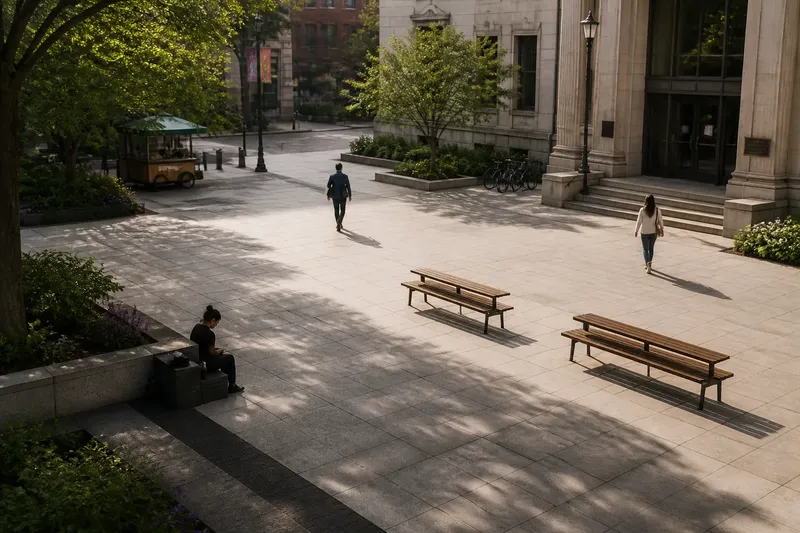
The street edge is not only the facade. It includes the small zones where a person moves from public pavement toward a door or window: a stoop, a shared entry court, a canopy, a low fence, or a strip of paving. These transitions can make a frontage feel close at hand even when the wall is set back, or make it seem distant despite being near the sidewalk.
In the invented situation, the apartment entry recess is deep enough to create a sheltered pocket, but the shrubs beside it screen part of the wall. The café’s windows sit directly on the street-facing plane, with chairs set behind the glass. A passerby can read the café as active and the apartment entry as a distinct threshold, though neither observation tells the walker who may enter or what is happening indoors.
Also notice whether transitions repeat. A sequence of small stoops or entries can give a long block a steady rhythm. One broad setback among close-set facades may stand out as a pause. Repetition and contrast are both worth describing; neither is automatically better, because the question is how the edge shapes this particular stretch.
Keep public space and private frontage distinct in your notes. A paved area that looks like an extension of the sidewalk may belong to a building, while a recess may remain part of the public route. If access, ownership, or permitted use matters to your observation, check posted information or the relevant local source rather than inferring it from appearance.
What does the street edge tell you?
Does a setback always reduce enclosure?
No. A setback can loosen the building line, but columns, planting, a low boundary, or neighboring facades may still define the walking space. Record what occupies the gap before deciding whether the edge feels continuous or interrupted.
Do more windows make a street edge feel stronger?
Not necessarily. Windows can add visual activity, yet a facade may still sit far behind an open forecourt. Their placement, visibility, spacing, and relationship to the pavement all shape the impression.
How can I compare two different frontages fairly?
Use the same stretch of pavement and note the same features on each side: building line, setbacks, openings, and transition spaces. Then describe the contrasts rather than treating one frontage as a universal standard.
Should I include what people are doing?
You can note visible activity, such as someone entering a shop, but keep it separate from the physical description. A quiet moment does not establish that a frontage is unused, and a busy moment does not explain its design by itself.
Turn the walk into a useful account
At the end of the hypothetical route, the walker has a clear result: the block’s enclosure comes from a mostly continuous building line, with a few setbacks that create pauses; frequent café windows open one section visually; and a long apartment wall makes another section more solid, softened locally by a recessed entry. The corner changes the pattern again as the next facade returns close to the pavement.
That conclusion stays close to what the walk revealed. It does not claim that every passerby feels the same way, or that a particular arrangement causes a specific behavior. It gives a reader enough detail to picture the street edge and understand where its sense of enclosure tightens, loosens, or shifts.
For your own street-edge notes, a compact sequence works well: trace the building line, mark each notable setback, identify ground-floor openings, and describe the transition between facade and footway. Add one sentence about where the edge feels most continuous and one about where it changes. This is enough to make an observation specific without turning a walk into a survey.
On the next block, notice the corner before you leave it. A facade that ends abruptly, turns with the street, or pulls away at the intersection can change how the edge carries into the next route. That final glance often reveals whether the enclosure you traced belongs to one frontage alone or continues as part of a larger street pattern.