The Empty Plaza Myth: Why Few People in a Space Does Not Explain It
The empty plaza myth turns a quiet moment into a verdict. Learn to read layout, purpose, timing, and nearby activity before judging a public space.
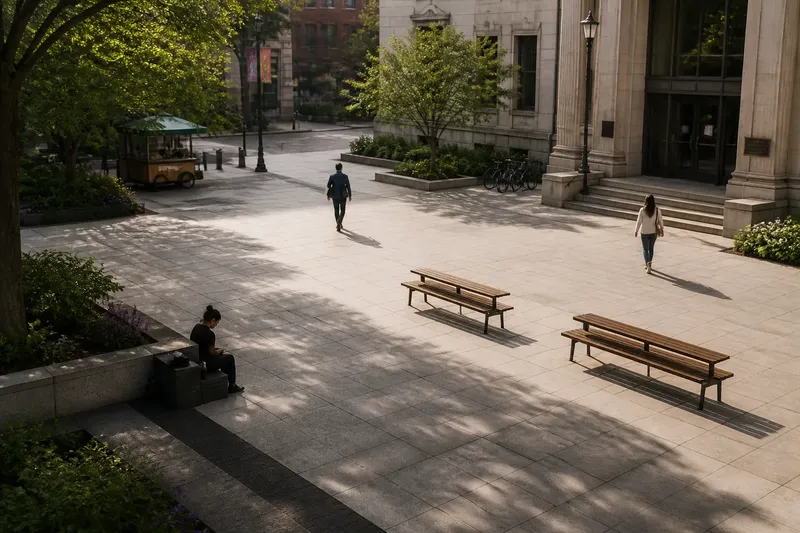
A plaza with only two people in it may be working exactly as intended. The empty plaza myth treats a quiet moment as a verdict on the whole space, but a careful reading starts with what the place makes possible, when people might use it, and what is happening around it.
Take a notebook or use your phone’s notes app, then visit without deciding in advance that the plaza is a success or failure. Move through the observations in order: establish context, inspect the layout, watch for activity, and compare what you see at another time.
Start by identifying what the plaza is for
Before counting people, look for clues to the space’s purpose. A paved forecourt beside a civic building may mainly provide a clear approach and a place to gather during events. A pocket plaza among shops may invite lunch breaks, waiting, or casual conversation. A landscaped square might be designed for lingering, but its benches and paths should make that intention legible.
Notice visible features rather than assuming the designer’s intent. Are there seats, shade, a fountain, a stage, a broad route between entrances, or a clear open area? A plaque, posted schedule, or sign may explain a formal use. If the purpose remains unclear, write down more than one possibility instead of picking the most convenient explanation.
This distinction matters because different uses leave different traces. A pass-through space may be busy with people crossing and nearly empty of sitters. A place intended for gatherings can be quiet between events. Neither pattern, on its own, tells you whether the plaza serves its surrounding area.
Read the layout from more than one position
Walk the perimeter, then cross the plaza along the routes people appear to take. Look for entrances, exits, desire lines, changes in paving, and places where paths meet. A broad, unobstructed center can feel empty while still carrying people efficiently from one side to another.
Then check where a person could comfortably pause. Look for benches with a view of activity, ledges that appear intended for sitting, shelter from sun or wind, and places that feel separated from moving foot traffic. Note obstacles too: a planter may provide greenery but also narrow a route, while a large sign or temporary barrier can redirect movement.
Don’t confuse visual openness with usefulness. A space can be open because it hosts occasional events or keeps a building entrance clear; that same openness may offer few reasons to stay on an ordinary day. Record the difference between “easy to cross” and “pleasant to occupy.”
Watch what people do, not only how many appear
Choose a place where you can observe without blocking a path, and pay attention to activity as well as presence. People may be walking through, waiting for someone, eating, talking, resting, supervising children, or attending to a posted event. A brief note such as “two people crossing, one waiting near the entrance” is more useful than “nearly empty.”
Notice how the space connects to nearby destinations. Do people arrive from a bus stop, a shop, an office entrance, or a side street? Does activity gather near a food cart or shift toward a shaded edge? These details help explain why one corner is occupied while another stays clear. Avoid interpreting a person’s purpose or identity; record only actions you can see.
Imagine arriving at a small plaza beside a library just after opening. You see a few people crossing toward the doors and nobody on the central benches. You note that the benches are in direct sun, while a shaded ledge sits near the entrance, then return later in the day. If readers, passersby, or an event group use the ledge at the later visit, that gives you a more specific account than calling the plaza empty.
Compare visits before drawing a conclusion
A single observation captures one combination of time, weather, nearby activity, and access. Visit again at a different time that fits the plaza’s likely uses: a lunch period for a business district, an after-school window near a school, or an event time shown on a public notice. If weather changes sharply, record that too; it can affect whether people choose exposed seats or covered edges.
Keep the comparison simple. Use the same vantage points, note the broad kinds of activity, and write down any change in the surroundings, such as a closed entrance or a temporary construction fence. You do not need a head count to notice a recurring pattern. Ask whether people pass through, pause, gather, or avoid particular parts, and whether that pattern shifts with the setting.
When a plaza is quiet on both visits, treat that as an observation, not a diagnosis. The space may serve an occasional purpose, lack comfortable places to stop, or be disconnected from nearby daily routes. Your notes can distinguish these possibilities without pretending to settle them.
What does a quiet plaza tell you?
Does a low number of visitors mean a plaza has failed?
No. A quiet visit says only that few people were visibly present at that moment, and the plaza may serve as a route, event space, or occasional gathering place. Compare its apparent purpose and activity across visits before making a broader judgment.
How long should I observe a public space?
Stay long enough to notice movement, pauses, and changes in activity, then make a second visit at a time suited to the place. A short, consistent observation is more informative than lingering without a question in mind.
What should I write down while observing?
Record the time, general weather, visible routes, available places to sit or shelter, and actions such as crossing, waiting, or gathering. Keep descriptions neutral and separate what you saw from what you think it might mean.
How can I tell whether the layout discourages staying?
Look for practical barriers to pausing, such as little shade, seats facing a blank wall, or resting spots beside a busy route. Treat these as clues to investigate alongside the plaza’s purpose and surrounding activity, not as a complete explanation by themselves.
Write a description that stays close to the evidence
When you finish, separate observations from interpretations. “The central area was clear, two people crossed toward the station, and the only shaded seat was occupied” reports what you saw. “People dislike this plaza” claims a reason you cannot establish from a glance.
For a useful account of the empty plaza myth, describe what the space seems equipped to support, how people moved through it, and what changed between visits. Mention uncertainty plainly. A reader can then picture the place and weigh your interpretation without mistaking one quiet moment for the whole story.
Carry that distinction to the next plaza you pass: ask what the space enables, who can reach it from nearby routes, and which conditions might change its use. The most useful observation may be not that nobody stayed, but that the available shade, seating, and paths directed activity somewhere else.